Sacred Space Ministries February "Month of Posture"
What We Learned
February 28, 2026
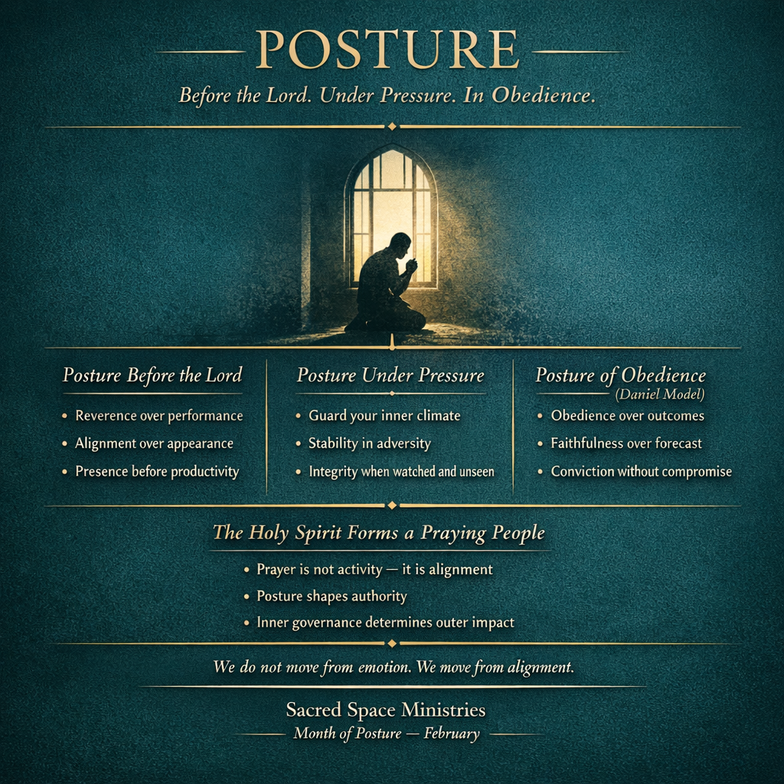
Ministry Analysis Report: Sacred Space Ministries February "Month of Posture"
1. Introduction to the "Month of Posture" Series
The February teaching series at Sacred Space Ministries represents a strategic progression from the January focus on "Hearing God" to the foundational requirement of "Posture." As established in the "Postured Under Pressure" sessions, posture is defined as the internal positioning of the spirit, mind, will, and body before God. It is an act of total submission—the transition from "my will" to "Thy will."
While January cultivated the ability to receive divine communication, February addresses the internal resolve required to carry the weight of what has been heard. Posture is explicitly distinguished from "performance." Where performance is an external religious act—often masking a private life that is out of alignment—true posture is a heart-set resolve that allows a believer to respond to environmental pressure with authority rather than reacting to it in fear.
2. Thematic Analysis: Definitions and Core Pillars
The ministry has introduced several critical pillars that define the believer’s internal alignment:
- Posture vs. Performance: Performance is "external religious acting" where the individual behaves as if they have a relationship with God without internal alignment. Posture is the authentic submission of the will that remains unshaken when the "wind blows."
- From "Fearful" to "Princes": This describes the identity shift from being "punks under pressure"—those who are spiritually weak and fold under trial—to "postured princes" who operate in royal authority. A postured prince stands on the Word and refuses to retreat from their assignment.
- Spiritual Weight (W-E-I-G-H-T): Rather than a burden of destruction, "weight" is characterized as a thematic wordplay on "waiting." It is the capacity formed through endured discipline. It serves as a corrective instrument; just as a physical weight reveals a slump, spiritual weight identifies internal imbalances to bring them into alignment.
- Nature and Appetite: There is a direct causality chain: Nature Appetite Alignment. When the Holy Spirit shifts a believer's nature, their spiritual appetite changes. Disciplines like prayer and fasting no longer feel like chores but become desires that "taste" good.
3. Biblical Case Study Analysis
The Daniel Model (Daniel 6)
Daniel serves as the primary archetype for marketplace excellence and spiritual resolve.
- Innocence as a Posture: A critical theological insight from the series is that Daniel’s survival in the lions' den was predicated on his "innocent" status before God. The ministry teaches that "Innocent" is a required posture. Today, this is maintained through the Blood of Jesus, which washes away the "guilt and shame" that the enemy uses to keep believers out of alignment.
- Excellence in the Secular Realm: Daniel's "spirit of excellence" in his government job proved that spiritual posture dictates professional distinction.
- The Secret of Consistency: Daniel did not start praying because of the crisis. He remained in the posture he had already established, praying three times daily "just as he had done before."
The "12-Year" Dual Narrative (Luke 8)
The ministry identifies a "12-year" connection to compare two distinct waiting postures:
- Jairus (Urgent Wait): Represents trusting God during an immediate crisis. Jairus had to "maintain his posture" even when his miracle was interrupted and he was told his daughter was dead. The teaching emphasizes that interruptions are tests of posture.
- The Woman with the Issue of Blood (Endurance Wait): Represents long-term suffering. Her posture required the humility to "push through the crowd" after twelve years of failed intervention to access the presence of God.
The Elizabeth and Zechariah Model
This illustrates the "Ordained Wait." Despite being righteous, they waited into old age for a child. This wait was a divine positioning for a kairos moment—the birth of John the Baptist. Their story proves that God sometimes delays a promise to align it with a specific prophetic timeline.
4. Strategic Framework: The "Technology of Prayer"
To move the congregation from emotional venting to authoritative communication, the "ALIGN" strategy has been implemented as the primary framework.
|
Component
|
Action Required
|
Scriptural/Thematic Goal
|
|---|---|---|
|
Acknowledge God
|
Focus on God’s sovereignty, holiness, and perfection.
|
Corrects posture by recognizing God as the source (Psalm 100:4).
|
|
Lay down weight
|
Repentance and shedding "false burdens" God did not assign.
|
Clears the "den of thieves" from the temple; stops emotional venting.
|
|
Invite Holy Spirit
|
Explicitly asking for the Spirit to pray through the believer.
|
Moves from human effort to Spirit-led intercession (Romans 8:26).
|
|
Go to the Word
|
Locating and praying specific scriptures.
|
God is obligated to perform His Word; it prevents "praying amiss."
|
|
Navigate in Spirit
|
Praying freely, pausing for downloads, and flowing in utterance.
|
Deepens intercession; utilizes the "technology of heaven."
|
The Four Postures of Prayer
- Waiting: Prayer that aligns the believer under tension, maintaining consistency until the breakthrough.
- Submission: The relinquishing of personal "hows" and "wills" in favor of God's sovereign path.
- Intercession: Standing as a bridge for the weak or for systems (like the nation) that lack the strength to pray for themselves.
- Persistence: An "arrested state" of prayer that refuses to leave the post until the answer is manifest.
5. Key Spiritual Insights and Breakthrough Deliverance
The ministry identified several specific "Breakthrough Targeted Areas" during the February services:
- Breaking Yokes: Targeting "yokes of iron and wood" that signify heavy spiritual bondage and legalistic ties.
- Mental and Emotional Strongholds: Binding spirits of "depression," "anxiety," "overthinking," and "overwhelmingness."
- The Posture of Innocence: Using the Blood of Jesus to break the "guilt and shame" that prevents believers from standing upright.
- The Great Exchange: Facilitating the trade of weariness, depletion, and "false burdens" for God's renewed strength and eagle-like stamina.
6. Operational Shifts for the Next Quarter
To ensure the "Month of Posture" results in permanent transformation, the following ministerial objectives are in effect:
- Congregational Consistency: Moving from "reactive" prayer (praying only during crisis) to "proactive alignment" where prayer is a constant characteristic, not a momentary event.
- Discipline Over Emotion: Training the body to rely on the "technology of heaven" (structured prayer) rather than their emotional states. Believers are commanded to pray whether they "feel like it" or not.
- Post-Breakthrough Restraint: Practicing "spiritual restraint" to avoid "aborting" a promise. This involves not prematurely exposing what God is doing on social media or to "the wrong people" before the work is finished.
- The Sabbatical Mandate: Emphasizing the Sabbath Sunday (February 22nd) as a mandatory corporate rest. The directive is explicit: "Do not come to the sanctuary." This rest is a vital component of spiritual posture.
7. Conclusion: Strategic Summary for the Season
The "Month of Posture" has served as a critical stabilization period for Sacred Space Ministries. By defining posture as an internal resolve rather than an external act, the teachings have equipped the body to handle the increased "spiritual weight" of the coming season. As we move forward, it is imperative that every member remains "planted on the solid rock" of foundational disciplines. This ensures that while God’s timing unfolds, the believer remains unmoved, upright, and fully capable of carrying the weight of His glory without collapsing.